
Radial Shockwave Therapy: What Does the Research Say?
What Is Radial Shockwave Therapy?
Radial Shockwave Therapy uses mechanically generated pressure pulses that spread outward from the applicator into a broad treatment area. Focused Radial Shockwave Therapy concentrates energy differently and may reach deeper targets. Both approaches are used in musculoskeletal medicine, but they are not identical. Research involving one type should not automatically be treated as proof that the other will produce the same result.
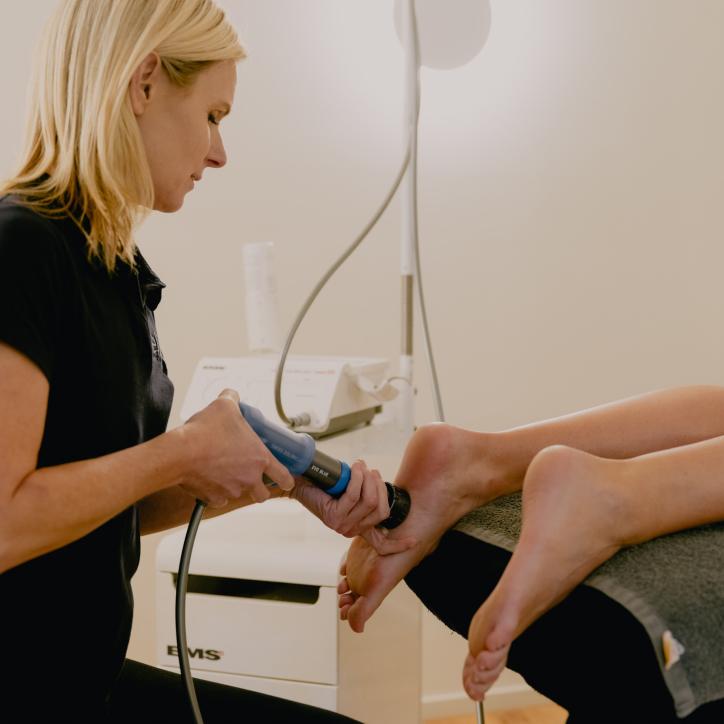
During treatment, a clinician applies gel to the skin and moves the device over the affected area. The pulses create rapid mechanical stimulation within the tissue. Researchers continue to study how that stimulation may influence pain signaling, circulation, cellular activity, and tissue remodeling.
The proposed process is often called mechanotransduction. In simpler terms, this means that cells respond to a mechanical signal. The full biological mechanism is not completely understood, so claims that pressure waves automatically “restart healing” or “regenerate tissue” should be interpreted cautiously.
Radial Shockwave Therapy is noninvasive and best viewed as one possible part of conservative care, not as a guaranteed cure.
Which Conditions Have the Best Evidence?
The quality of evidence varies considerably by condition. Treatment protocols also differ in the number of sessions, pulse settings, energy levels, and whether therapy is combined with exercise or another intervention.
That variation matters. A study showing improvement in one condition does not prove that the treatment works equally well for every type of joint, tendon, or muscle pain.
Chronic Plantar Heel Pain
Chronic plantar heel pain is one of the most commonly studied uses of Radial Shockwave Therapy. It is often associated with plantar fasciopathy, a painful condition involving the thick band of tissue that runs along the bottom of the foot.
A 2021 systematic review of randomized trials found moderate evidence that Radial Shockwave Therapy may improve pain and foot function in people with chronic plantar fasciitis. A 2024 meta-analysis found that treatment reduced plantar fascia thickness but did not provide significantly better pain relief than other nonsurgical interventions.
NICE, the United Kingdom’s health technology authority, has concluded that Radial Shockwave Therapy raises no major safety concerns when used for plantar fasciitis that has not responded to previous treatment. However, NICE also describes the evidence for effectiveness as inconsistent and recommends that patients be informed about that uncertainty.
The research suggests that Radial Shockwave Therapy may be helpful for selected patients, but it should not be promoted as a certain solution for every case of heel pain.
Calcific Shoulder Tendinopathy
Calcific rotator cuff tendinopathy is another condition with meaningful research behind Radial Shockwave Therapy. It occurs when calcium deposits develop within a shoulder tendon, potentially causing pain, stiffness, and difficulty lifting or moving the arm.
A 2024 systematic review involving 21 randomized trials found that Radial Shockwave Therapy performed better than sham treatment for pain and shoulder function at 24 weeks. However, the overall certainty of the evidence was rated very low. Ultrasound-guided needling produced better pain outcomes in some comparisons, and the researchers found no clear difference between focused and radial treatment.
These findings support a careful discussion of treatment options rather than a claim that Radial Shockwave Therapy is always the best approach. Imaging may also be needed to confirm that calcium deposits are actually present before treating the shoulder as calcific tendinopathy.
Knee Osteoarthritis
Research into Radial Shockwave Therapy for knee osteoarthritis has produced encouraging results, but important questions remain.
Recent reviews have reported improvements in pain and physical function following treatment. However, studies differ considerably in their treatment settings, energy levels, comparison groups, follow-up periods, and overall quality. Reviews evaluating the available evidence have therefore called for better-designed research and more consistent treatment protocols.
Radial Shockwave Therapy should not replace established osteoarthritis care. Depending on the patient, a broader plan may include strengthening, appropriate physical activity, weight management when relevant, medication discussions, and medical evaluation when pain or function worsens.
Achilles Tendon Pain
The evidence for Achilles tendinopathy deserves particular caution.
NICE previously concluded that the evidence was inconsistent and limited in both quality and quantity. More recently, a 2026 systematic review of nine randomized trials found no clinically meaningful overall benefit for pain or disability. Its authors concluded that Radial Shockwave Therapy should not currently be considered a routine treatment for either insertional or midportion Achilles tendinopathy.
A clinician may still discuss radial pressure wave therapy in an individual case, but patients should understand the uncertainty. Appropriate exercise-based rehabilitation and other conservative options should generally be considered as part of the plan.
Why an Accurate Diagnosis Comes First
Heel pain can result from plantar fasciopathy, arthritis, nerve irritation, a stress injury, or another condition. Shoulder pain may come from a tendon, bursa, joint, neck, or nerve. Knee symptoms may reflect osteoarthritis, a ligament injury, a meniscus problem, inflammation, or referred pain from another area.
Radial Shockwave Therapy should not be applied simply because a body part hurts.
A responsible evaluation may include questions about when the symptoms began, what movements make them better or worse, previous injuries, medical conditions, medications, work demands, exercise habits, and treatments already attempted.
The physical examination may assess strength, movement, tenderness, walking mechanics, neurological signs, and functional limitations. This information helps the provider decide whether pressure wave therapy is appropriate or whether another type of care should come first.
Imaging is not necessary for every patient. It may be useful when the diagnosis is uncertain, symptoms followed significant trauma, a fracture or tendon tear is suspected, or the findings would change treatment. Calcific shoulder tendinopathy, for example, is generally confirmed through imaging rather than symptoms alone.
What Does a Treatment Session Feel Like?
During an appointment, the provider identifies the treatment area, applies gel, and places the handheld applicator against the skin. The device delivers a series of rapid pulses that may feel like tapping, pressure, or repeated percussion.
Treatment can be uncomfortable, particularly over a sensitive tendon or bony area. The provider may adjust the intensity according to the patient’s tolerance and the treatment goal. Sessions are usually brief, although the exact duration and number of pulses vary.
Some patients report temporary relief or easier movement shortly after a session. Others improve gradually over several weeks, while some do not experience meaningful improvement.
Immediate pain relief does not necessarily mean that an injured tendon has healed. Pain can change before the tissue has regained strength or the ability to tolerate normal activity. Rehabilitation exercises and a sensible return to work, exercise, or sports may still be necessary.
How Many Sessions Are Needed?
There is no universal treatment schedule. Many research protocols have used approximately three treatment sessions separated by one week, but the appropriate schedule may differ according to the condition, device, treatment settings, and patient response.
A responsible treatment plan should include measurable goals. These may involve:
- Morning heel pain
- Walking or standing tolerance
- Shoulder movement
- Ability to use stairs
- Grip strength
- Ability to return to work or exercise
When to Seek Medical Evaluation Instead
Radial Shockwave Therapy is intended for selected musculoskeletal conditions. It is not appropriate for unexplained symptoms or medical emergencies.
Prompt medical attention is appropriate when pain follows major trauma or occurs with severe swelling, visible deformity, inability to bear weight, fever, spreading redness, significant numbness, progressive weakness, chest pain, or shortness of breath.
Sudden pain accompanied by a popping sensation, immediate weakness, or difficulty using the affected limb also requires evaluation before local treatment is started. Persistent night pain, unexplained weight loss, fever, or a history of cancer should be discussed with a medical professional.
Where It Fits in a Complete Care Plan
Passive treatments may reduce symptoms, but lasting progress often depends on addressing why a muscle or tendon became irritated or overloaded.
That may involve progressive strengthening, mobility work, footwear changes, activity modification, movement coaching, workplace adjustments, or a gradual return to exercise and sports.
For many tendon conditions, exercise-based rehabilitation remains an important part of care. Radial Shockwave Therapy may be used alongside that work rather than as a replacement for it.
The provider should explain the diagnosis, expected benefits, uncertainty in the evidence, possible side effects, available alternatives, and the role of home care. Treatment should be adjusted when progress is limited or the patient’s circumstances change.
Delaware Integrative Healthcare provides radial pressure wave therapy for selected pain and soft-tissue conditions. Its service page lists plantar and heel pain, shoulder pain, knee pain, muscle pain, trapezius discomfort, and Achilles tendon pain among the concerns its providers evaluate.
Is Radial Pressure Wave Therapy Right for You?
Radial Shockwave Therapy may be worth discussing when a properly diagnosed musculoskeletal condition has not improved enough with initial conservative care.
It is most reasonable when the provider can explain why the treatment fits the diagnosis, how progress will be tracked, and what other parts of the plan will support recovery.
The evidence is stronger for some conditions and uncertain for others. Patients deserve more than a promise that a device will make pain disappear. They deserve a clear diagnosis, realistic expectations, informed consent, and a plan that can change if treatment is not helping.
At Delaware Integrative Healthcare, an evaluation can help determine whether Radial Shockwave Therapy, physical rehabilitation, another conservative treatment, or referral for additional medical care is the most appropriate next step.
Contact Delaware Integrative Healthcare Today
At Delaware Integrative Healthcare, our specialists are committed to helping you find relief from migraines. Our experienced chiropractors will use a comprehensive approach to diagnose and treat your condition to give you the best results possible. We can provide treatments that may include spinal adjustments, myofascial release, lifestyle advice, and nutritional guidance.
By taking into account any underlying conditions or history of migraine headaches, we'll be able to determine what kind of intervention would be most effective for relieving your pain.
If you want to help to manage your migraine symptoms, contact us today at Delaware Integrative Healthcare and let us work with you to develop a personalized strategy. Our dedicated team is here to answer any questions about how chiropractic care could benefit you – call now!
Related Care and Resources
Patients can request an evaluation at our Middletown, Milford and New Castle locations.
Schedule Your Next Step
Learn more about Dr. Trevor Ennis. New patients can request an appointment online, and current patients can use the existing-patient scheduling page.
This article provides general educational information and does not replace an individualized evaluation or medical advice.